Балансировочные машины SCHENCK серии Pasio 5, 05, 005 - страница 6
Навигация
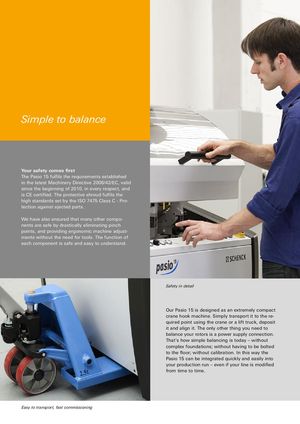 Балансировочные машины SCHENCK серии Pasio 15
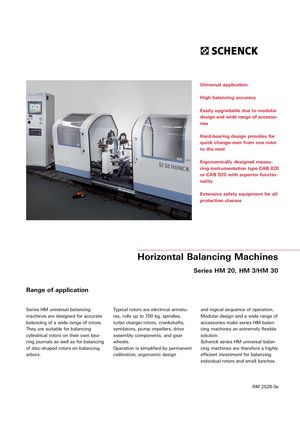 Балансировочные машины SCHENCK серии HM 20, HM 3, HM 30
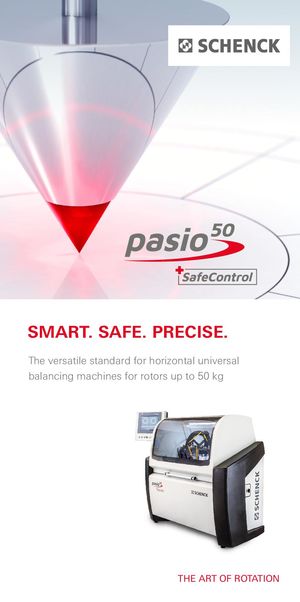 Балансировочные машины SCHENCK серии Pasio 50 SC
 Балансировочные машины SCHENCK серии Distec
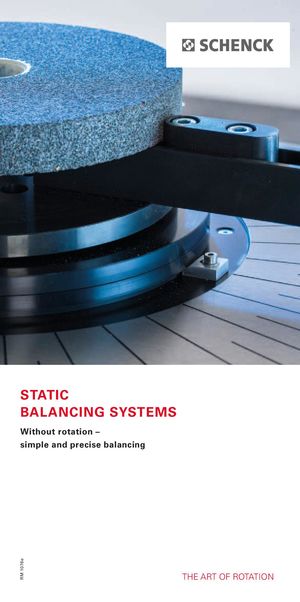 Балансировочные машины SCHENCK серии Static Balancing SyStemS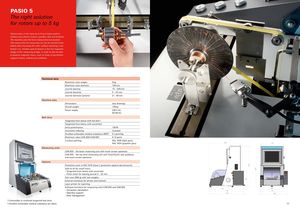
PASIO 5
The right solution
for rotors up to 5 kg
Typical rotors in the class up to 5 kg include small to medium-size electric motors, spindles, fans and turbines. The machine uses the force measurement procedure. This means that the measuring run can be started immediately after mounting the rotor, without requiring a calibration run. Another special feature is the non-magnetic design of the measuring bridge, in order to also be able to balance magnetic rotors, such as those of permanent magnet motors, without any problems.
| Technical data | ||
| Maximum rotor weight | 5 kg | |
| Maximum rotor diameter | 150 mm | |
| Journal spacing | 15 – 240 mm | |
| Journal diameter | 5 – 22 mm | |
| Journal diameter optional | 21 – 40 mm | |
| Machine data | ||
| Dimensions | (see drawing) | |
| Overall weight | 135kg | |
| Power supply | 230V AC, 50 / 60 Hz | |
| Belt drive | ||
| Tangential from below with flat belt1) | ||
| Tangential from below with round belt | ||
| Driveperformance | 100 W | |
| Automatic indexing | included | |
| Smallest achievable residual unbalance KER2) | 0.1gmm/kg | |
| Maximum value CAB 820 / CAB 920 | 0.15gmm | |
| 2-colour painting | RAL 7035 (light grey), RAL 7024 (graphite grey) | |
| Measuring units |
Options
1) Convertible to overhead tangential belt drive 2) Smallest achievable residual unbalance per plane
CAB 820 – the basic measuring unit with touch screen operation CAB 920 – the top level measuring unit with SmartTouch user guidance and touch screen operation
Protective cover to ISO 7475 Class C (protection against ejected parts) Add-on kit for small rotors – Tangential from below with round belt – Prism insert for bearing journal 2 – 22 mm Test rotor (500 g) with test weights External interfaces for printer and network Laser printer for reporting Software functions for measuring units CAB 820 and CAB 920 – Correction calculation – Operator support – Data management
11